| This interview is with Murali K. Menon, of the Indian Express newspaper (damn cool summary of latest Indian news online). Muralibhai, by the way, was a very nice guy, and I thoroughly enjoyed the interview. Q. 1) You were a published writer in your 20s, much before Mumbai happened? What kind of stuff did you write then? A. 1) That’s a damn fine question, Murali. That’s a char sol bis (420) question. It’s great to start an interview with a question I’ve never been asked. Okay, as a young writer, I was drawn to the same sorts of themes and scenarios that still capture my interest today: love and pride; sin and suffering; hope and greed; the moral act and actor in a situation of turmoil; the hero as villain, and the villain as hero; the search for meaning in a world that seems absurd; and all the passionate exaltations of art. The major differences between my early work as a writer at the beginning of the wordsmith journey and today are these: i) As a young man I never wrote myself into my work – I was always the invisible, omniscient author – whereas today I often include the created version of myself in my work; ii) My work then was haphazard, almost a kind of automatic writing, but now everything I write is informed by a literary theory that I’ve developed through 30 years of experience; iii) In my youth I searched for meaning blindly, seizing upon
and displaying fragments of knowledge in much the same way that some kinds of
birds will seize shiny objects for their nests. The young writer worked from
intuition alone, and while the baubles of instinct sparkle with a mystic lustre,
they’re brittle slivers of glass that crack and shatter if we hold on
to them too tightly. Now, after 30 years of study in the fields of particle
physics, theology, biology, philosophy, anthropology, psychology, archaeology,
geophysics, cosmology, complexity theory, astrophysics, game theory, and other
disciplines, I’ve drawn a few conclusions about the nature of the universe,
and of our place in it. As a result, my writing today is founded on that bedrock
of essential truths and passionate experiences. Q. 2) You probably travelled to a lot many cities? What makes Mumbai, if at all, special? A. 2) I love Bombay, so I see Her through the parallax of love.
I’m not blind to Her faults, and I know that She can be the most frustrating
city in the whole world of my experience. Most Mumbaikers will tell you that
they say, at least once every day, “God, I hate this city!” But
the same people, me included, will also tell you that at least once every day
they say out loud, even if only to themselves, “God, I love this city!” Q. 3) I haven't read the book yet. Will get my hands on it tomorrow as soon as it gets launched here in Mumbai. But tell me, you were Linbhai, Linbaba, and even a Bollywood stuntman. How was it like living through those times, being different things to different people? A. 3) We are all – every one of us – different things
to different people. We are father to a young child, with a set of reactions,
gestures, and expressions that are appropriate to that role. But none of us
translate that same set of gestures and expressions to our roles in say, the
business world. We are lovers, most of us, who express all the tenderness that
intimacy inspires, yet we wouldn’t show that same intimate tenderness
to the strangers we meet on a crowded train. We are all living out roles that
define the different sets of interactions involved in the activity of being
a social being. In my case, the roles were more extreme than they are for most
people, but the experience of differentiation is the same. Q. 4) What was the mafia like, as good or as bad, as 'normal' people around you? A. 4) I don’t believe that there are Good men or Bad men.
I believe that the deeds we do are Good and Bad, not the men and women who commit
them. The best of us can do Bad things, and the worst of us can do Good. I’ve
known mafia men who took responsibility for feeding the poor in their district,
and I’ve known cops who were ruthlessly cruel. We human beings are just
that – human animals with the capacity to do Good or to do Bad –
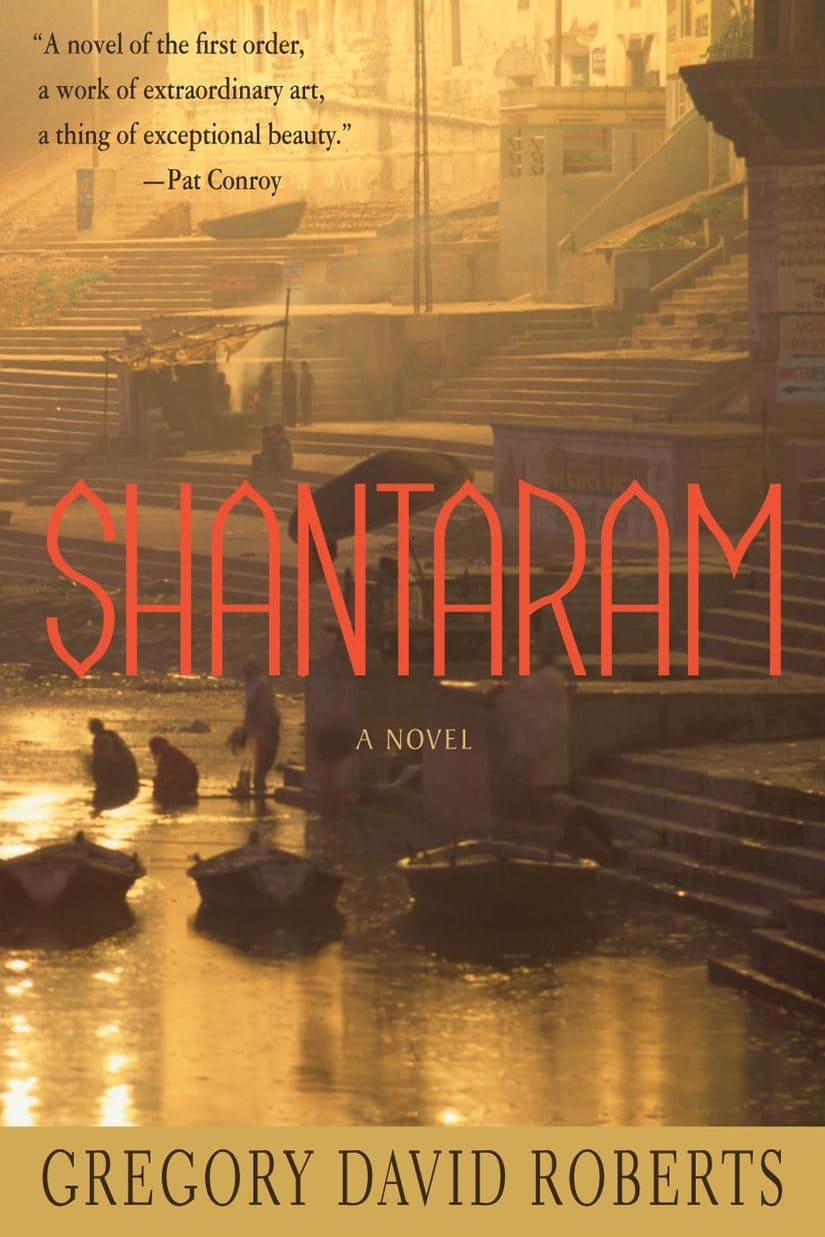
and we all do both, to a greater or lesser degree. Q. 5) The mafia, love, loss, your book has all the ingredients of a great read. But what if Roberts was an ordinary expat in Mumbai, with literary ambitions and a normal life? Would the city still have acted as a spur for a non-autobiographical literary endeavour? A. 5) A city, when all’s said and done, is the sum of its people. A novel, in a very similar way, is the sum of its characters. The sum of the people I came to know in Bombay was such that I had no choice but to write them. Every market street, every lane in the zhopadpatti, every motor cycle ride, and every rose-drenched evening sky reflected in the eyes of a pretty girl forced me to write my own eyes and hands and lips onto the page. This is Bombay, amchi Mumbai, we’re talking about, Murali: I would’ve been inspired to write there, no matter what my circumstances. Q. 6) When did the idea of an autobiography, with the city both as a character and as a backdrop, first strike you? A. 6). With respect, Shantaram is not an autobiography, it’s
a novel. If the book reads like an autobiography, I take that as a very high
compliment, because I structured the created narrative to read like fiction
but feel like fact. I wanted the novel to have the page-turning drive of a work
of fiction but to be informed by such a powerful stream of real experience that
it had the authentic feel of fact. Q. 7) From a most-wanted man to a fugitive to writer (three more books are set to follow Shantaram, isn’t it?), but what does life look like now, when life itself is so much more predictable? A. 7) There’s nothing more exciting, rewarding, or challenging
than doing what you’re born to do. I think there are two kinds of
writers in the world: those who think it’s a good idea to be a writer,
for whatever reason, and those who write because they have no choice but
to write. I’m the second kind of writer. It was always my first instinct
to write. When I was chained to a wall in Arthur Road prison and being tortured
by convict overseers, one part of me was writing the experience even then,
in the bloody, lacerating bite of the lathis. To be able to write now, as
a free man, and to be published internationally, is the realization of my
deepest and most cherished desire. |